【今年度の活動報告】第41回高等学校英語弁論大会に出場しました
クラーク高校では、校内の活動以外にも多くの生徒が校外でのコンテストや大会に挑戦しています。今回は11月に出場した「第41回高等学校英語弁論大会」のレポートをご紹介します。
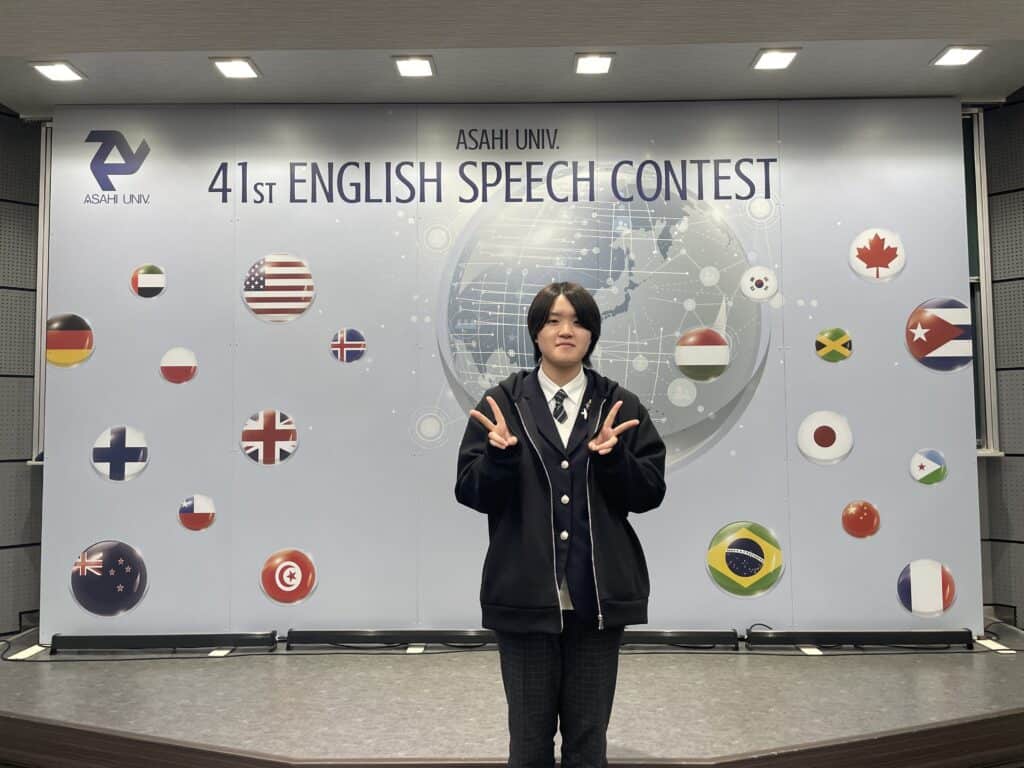
11月、岐阜県の朝日大学にて「第41回高等学校英語弁論大会」の本選が開催され、本校2年生のYさんがファイナリストとして出場しました。
今年度は全国から126名の応募があり、その中から約20名のみが本選に進出しました。Yさんは予選のスピーチ原稿が高く評価され、見事ファイナリストに選出されました。
本選当日、Yさんは自身の経験や考えを丁寧に言葉へと紡ぎ、聞く人の心に残るスピーチを堂々と披露しました。惜しくも入賞とはなりませんでしたが、全国規模の舞台でしっかりと存在感を示し、大きな成長を感じさせる立派な発表となりました。
Yさん、本当にお疲れさまでした。今後のさらなる飛躍を心より楽しみにしています。応援してくださった皆さまにも、温かいご声援をありがとうございました。
【本選スピーチ原稿】
To Knock Is To Reach
Hello. Are you enjoying the game?
I spoke to a girl standing next to me.
We had just stopped playing a sport in the gym, and the temperature around us was extremely high. My movements were slow, and I spoke in Japanese to calm myself down.
She looked surprised that I was using sign language. Then, she silently waved her hand. It meant “clap” —but to my heart, it felt like a knock, an invitation. The air between us was calm, yet I was so full of joy I couldn’t hide.
That moment completely broke my shell. I was so excited that I could hardly sleep.
I stayed in Laos, a multi-ethnic country in Southeast Asia, for a week in March this year. The goal was to host a universal sports event with locals who had disabilities. Universal sports, in other words, are activities that both people with and without disabilities can enjoy—together, without barriers.
Before the event, I thought long and hard about how to improve the games. I also studied Lao and some basic sign language. At first, it was just all fun for me. That’s it. Just for fun. I never even expected to get closer to the locals. In Laos, most people don’t speak Japanese, and even English is rare. On top of that, I couldn’t use my smartphone outside the hotel.
But on the second night at dinner, I met eyes with a local student across the table. I wanted to say something—but no words came. So I smiled. She smiled back. Then, she showed me her phone and started typing. Using a translation app, we began talking—and we kept taking all through dinner. It created a space full of warmth and joy. The fact that I had connected with her―in Lao―stayed in my mind long after.
Thanks to this, I was able to talk to participants more actively. During the game, I noticed a younger girl watching me from a short distance. I wanted to tell her, “Go for it,” but I didn’t know how to express it in sign language. She didn’t speak, but when I smiled and waved, she smiled and responded with signs I couldn’t fully understand. We shared gestures, laughter, and simple hand movements. We played the game as teammates―no words, just smiles. In that moment, I felt something deeper than conversation.
Until then, I had been in a different kind of conversation—using carefully memorized Lao phrases with the students, trying to connect only through the language I was used to. I felt proud to be able to communicate. But then, I realized: words can help, but they can also limit.
On some days even now, I still hear the sound of balls bouncing and laughter in my memory. On the day I left, the girl gave me a sign name—something unique to me. These memories have kept knocking at my heart since the flight home. What remains in my mind even now is not the words, but relationships I built with people.
Her silent wave was like a knock—soft, uncertain. But somehow, it reached me, just like, if not more than, the conversation with the student did. Now that I think about it, I’ve come to understand. Sometimes, a simple knock—a wave or a smile—can reach further than words ever could.
Now, I’ve become more open to the possibilities beyond language—spoken and written. Of course, language is important and necessary for everyone. But language is so much more than words and sounds.
To knock is to reach—and sometimes, that knock doesn’t need any words at all.